Commercial · Stamford Centre
Commercial Rekeying in Stamford Centre
The drawer behind the counter holds a tangle of keys with tape labels: front old, side, Dave. Some open things, some open nothing, and the hardware-store copies mean the true count drifted long ago past anything written down.
Commercial Rekeying
In plain words
Rekeying is also a chance to decide how the keys should work, not simply to change them. Most businesses settle on a small number of key groups: one key for the doors every employee uses, another for the office, cash room or server closet that only managers open, and perhaps a single master for the owner that opens everything. The locksmith maps this out on a keying chart before touching a cylinder, then pins each lock so the plan holds true on the door. Staff carry one key instead of a ring, managers carry two, and the chart tells you at a glance who can open what.
How the visit goesThe office has been reshuffled twice since the locks were last touched. Reception can open the server room, the warehouse crew has a key to accounting, and the chart that once explained who could open what has not been seen since the move.
Stamford Centre
How the visit goes
Which doors are the landlord's
In a plaza, an office building or a multi-tenant industrial unit, some doors on your floor plan are not yours to rekey. Corridor doors, electrical and mechanical rooms, shared loading doors and the building's fire exits usually sit on the landlord's master system, and a suite entrance may be required to accept the landlord's key as well as yours. The locksmith sorts the openings into two columns before starting: those the lease puts under your control, which get the new plan, and those that stay as they are or need the property manager's say-so. Where a suite door must accept both a tenant key and the building master, it is pinned to do exactly that.
Swapping interchangeable cores
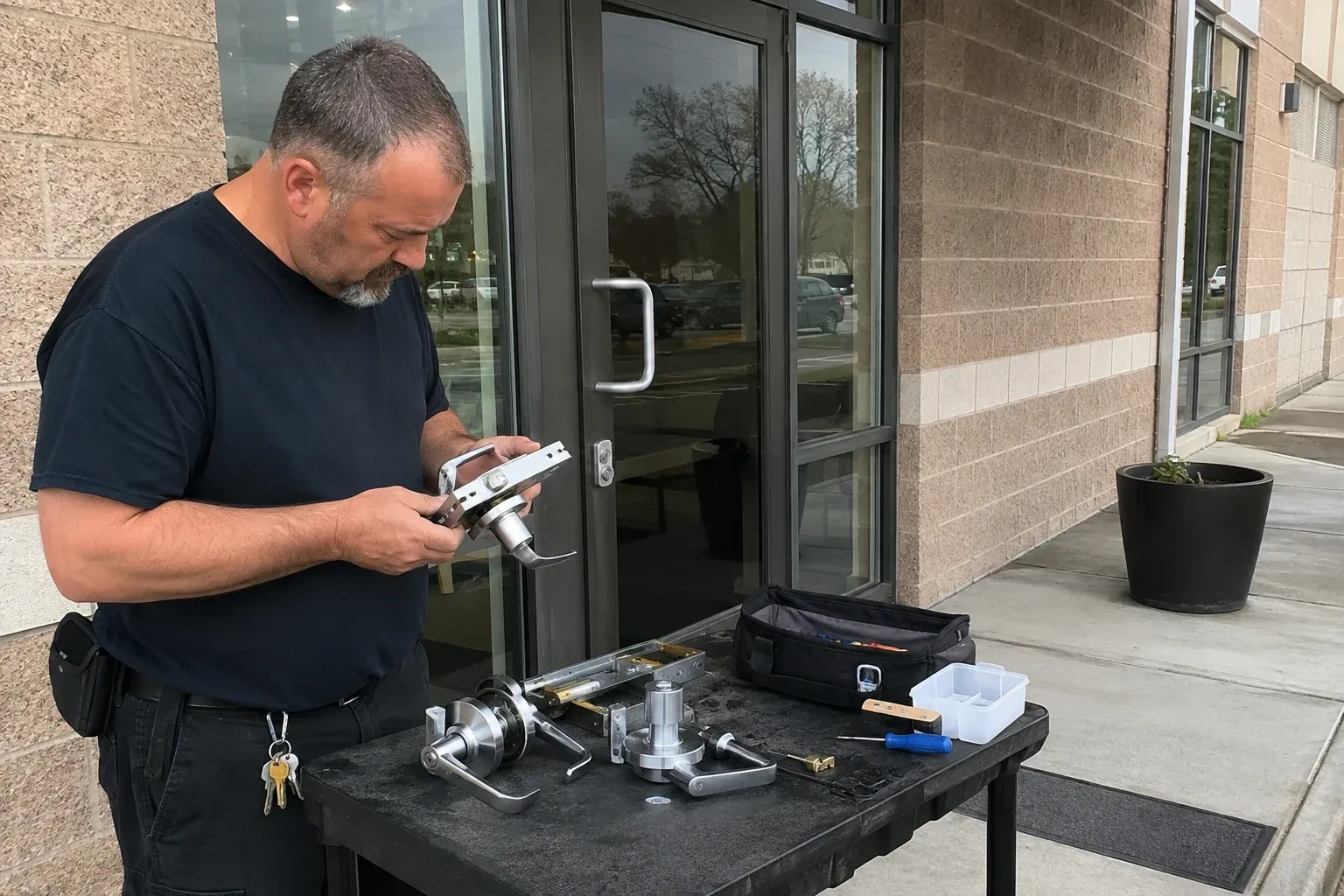
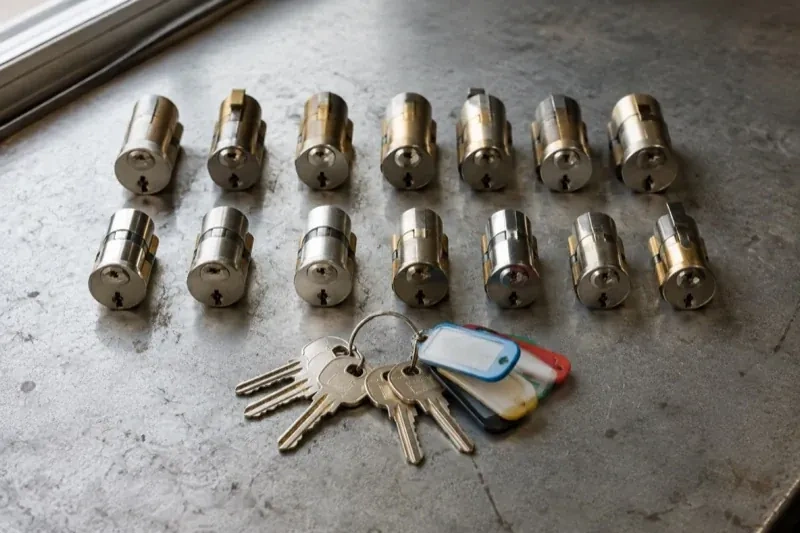
Where the business already runs on interchangeable cores, the door hardware never comes apart. The control key goes into the figure-eight core, turns a few degrees, and the whole core slides out of the lever or padlock in one piece. A freshly combinated core goes in the same way, the operating key is tried, and that door is done. The old cores travel back to the bench to be repinned for another opening or held as spares. This is what makes cores so well suited to businesses with steady turnover: a single control key, kept in the manager's safe rather than on a ring, is all it takes to change a lock.
A routine for the next departure
Turnover stops being a security event once there is a procedure for it. When someone leaves, their key is collected against the register and ticked off; if it cannot be produced, the chart shows exactly which cylinders that key opened, and only those are dealt with. Businesses that chose interchangeable cores can go further: the manager takes the control key from the safe, swaps the affected core for a spare in less time than a coffee break, and the locksmith repins the removed core at leisure for the next time. Either way the response is measured and specific, and the front door is never left answering to a key that walked out with a former employee.
Commercial Rekeying
In the van
- Plug follower
- Key stamp set and tags
- Standard and restricted key blanks
- Code key machine
- Master pins
What affects the quote
Same fees day, night or weekend
1After-hours or split visits
Work done after closing, before opening or split across two visits to suit trading hours costs the same amount as a single daytime block. The exact figure is confirmed on site once the number of cylinders and the keying plan are known.
2Documentation and register
A keying chart, a key register and stamped codes on every key are part of a proper commercial rekey, and the quote names the paperwork so it is never skipped.
3How many keys are cut
Each key cut to code and stamped is counted into the quote. Two per door group for a small shop and forty for a warehouse shift are different numbers.
Commercial Rekeying: questions
What is a master key system and does a small business need one?
In a master key system each lock accepts its own change key and also a master key above it, so a manager carries one key while staff carry keys that open only their own doors. Small businesses with three or four doors often manage without one. A master earns its place once there are several rooms with different people in them, or several locations, and the owner would otherwise carry a ring of keys.
How do you confirm I am allowed to have the locks changed?
For a business the locksmith looks for someone with standing: the owner, a director, or a manager who can show written authority from one of them. A lease, a business registration or a letter on company paper usually settles it, along with photo identification. Where doors belong to a landlord, the property manager's approval is asked for as well. This is a short step and it protects the business from having its own locks changed by the wrong person.
How long should we set aside for a commercial rekey?
It depends on the count and the mix. A shop with a front door, a back door and a stockroom is a short visit; an office suite with a dozen lever sets, a master key plan and a mailbox takes a good part of a day. Interchangeable cores are the shortest of all, since they are swapped rather than repinned on site. The locksmith gives a time estimate at the assessment, once every cylinder has been counted.
Commercial Locks
- Access Control InstallationAnother employee left and the keys never came back.
- Panic & Exit HardwareThe daycare wants the yard gate and the classroom door alarmed so a staff member hears the moment…
- Commercial-Grade Lock ReplacementThe kitchen delivery door gets shouldered open more than a hundred times a shift, and lately the…
Commercial Rekeying near you
The services below cover most of what a door in Stamford Centre can throw at you. Some are urgent, like a lockout or a snapped key. Others are planned, like upgrading to a high-security cylinder or setting up a master key system for a small building. Each one is explained in plain terms so you know what to expect.