Commercial · Stamford Centre
Master Key System Design in Stamford Centre
A property manager taking over a small commercial building inherits a shoebox of keys with no labels and no chart. Some open the mechanical room, some open vacant units, and a few do not seem to match anything currently on the property at all.
Master Key System Design
In plain words
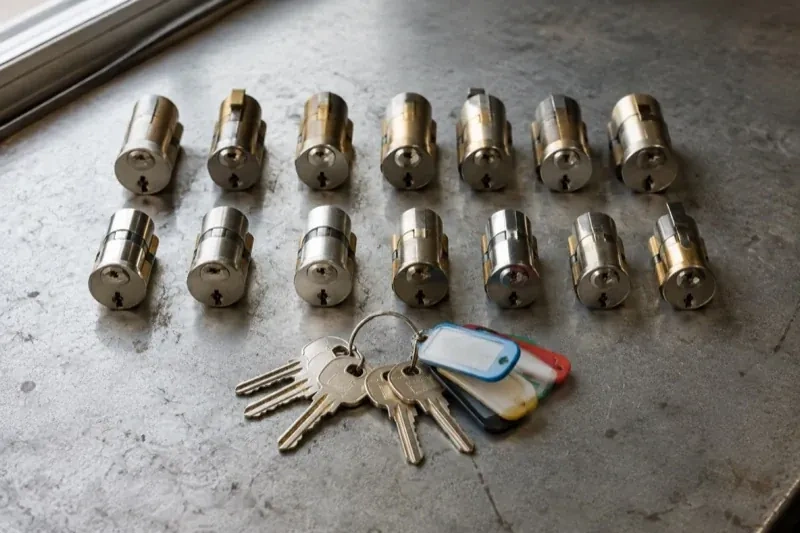
Master key system design is the work of turning a property's separate locks into one coherent hierarchy: a change key for an individual door, a sub-master over a department or floor, and one top-level master reserved for the few people who need it. The locksmith records who should open what, matches that list to the cylinders already installed or to new ones chosen for the job, and pins every lock so each key opens exactly its intended group. The finished system comes with a chart the owner controls, so access follows the organization instead of following whoever happened to be handed a spare key.
How the visit goesThe new wing was built with its own brand of cylinder, so the two-year-old keys from the original building do not open a single door in the addition. Staff are now carrying two separate key rings just to move around one workplace.
Stamford Centre
How the visit goes
What a shared or multi-tenant building already has in place
Where the property sits inside a larger building, the check looks at what is already shared: a condominium corporation's own lobby or garage system, a landlord's building-wide master, or another tenant's separate keying. The new hierarchy is designed to sit alongside those systems rather than to cut across them, so a tenant's own suite keeps its own private levels while common areas continue to answer to whoever already manages them. Sorting this out first avoids designing a system that quietly conflicts with access someone else controls.
Choosing a platform with room in it
The keying platform and keyway are chosen to hold every level the design calls for, plus a margin for doors that are likely to join later. Each cylinder is then pinned chamber by chamber to the planned bittings, with bottom and master pins stacked together to create the shear lines every level needs to turn that one cylinder. Getting this stacking right is what prevents a common mistake: a change key that, through an overlooked shared pin, quietly opens more than the door or keyed-alike group it was meant for.
A building that finally matches its own org chart
The most visible change is often the simplest one: the level of key someone carries now matches the role they actually hold, instead of matching whatever happened to be handed down or copied over the years. Walking the building afterward, each door answers to keys that were deliberately assigned to it, and the chart in the office explains every one of those decisions to anyone who asks about it.
Master Key System Design
In the van
- Bench test fixture
- Keying chart
- Change and master keys
- Master pin kits
- Plug follower and key gauge
What affects the quote
Same fees day, night or weekend
1Compatibility of existing hardware
Cylinders that can join the new hierarchy without modification keep the project smaller. Hardware that is mismatched, worn or built on an incompatible keyway needs replacing to fit cleanly into the plan, and that replacement hardware is a separate line from the design and pinning work.
2Any optional upgrade chosen along the way
Some businesses use the project as an opportunity to also upgrade a door closer, add a keypad to one entry, or reinforce a strike plate. None of this is required for the master key system itself, and each optional item is quoted as its own line.
3Sub-master levels beyond the basics
One or two sub-master levels are typical for most properties. A more elaborate hierarchy, with several sub-masters covering overlapping departments or floors, takes longer to design correctly and test, and that additional design and testing time is reflected in the quote.
Master Key System Design: questions
How is the key chart kept private?
The chart is handed to a named administrator rather than left as loose paperwork, and it is stored somewhere only that person can reach, separate from day-to-day office records. It is not published, circulated widely or kept alongside general building documents. When the administrator role changes hands, custody of the chart moves with a signed acknowledgement rather than being passed along informally.
How does a master key system work in a shared or multi-tenant building?
A tenant's own hierarchy for their suite is designed and held separately from the building's shared systems, such as a condominium corporation's lobby or garage keying or a landlord's building-wide master. The two sit alongside each other rather than merging, so a tenant's private levels stay private while common areas continue to answer to whoever already manages them.
What is the difference between a master key and a sub-master?
A sub-master sits below the top level and opens a defined group, such as one department or one floor, without opening doors outside that group. The top-level master sits above every sub-master and opens everything in the system. Most properties need only one or two sub-master levels; adding more than the business genuinely uses just makes the chart harder to manage without adding real convenience.
Commercial Locks

- Access Control InstallationAnother employee left and the keys never came back.
- Panic & Exit HardwareThe daycare wants the yard gate and the classroom door alarmed so a staff member hears the moment…
- Commercial-Grade Lock ReplacementThe kitchen delivery door gets shouldered open more than a hundred times a shift, and lately the…
Master Key System Design near you
The services below cover most of what a door in Stamford Centre can throw at you. Some are urgent, like a lockout or a snapped key. Others are planned, like upgrading to a high-security cylinder or setting up a master key system for a small building. Each one is explained in plain terms so you know what to expect.