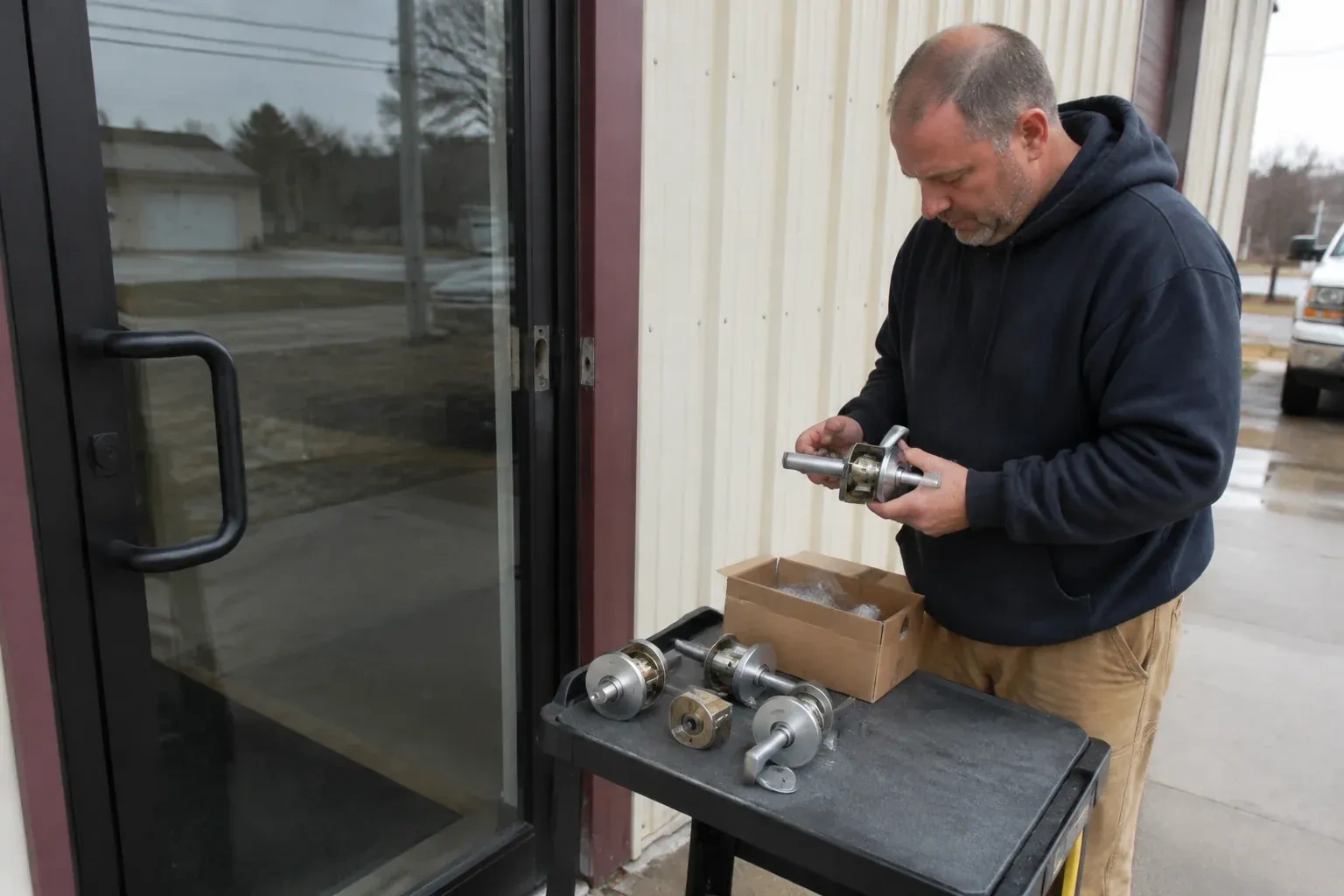
Commercial · Stamford
Commercial-Grade Lock Replacement in Stamford
The kitchen delivery door gets shouldered open more than a hundred times a shift, and lately the latch slips past the strike plate instead of catching it on the first push.
Commercial-Grade Lock Replacement
In plain words
Fire separations and exit routes add a layer that a house entry door never has, and this service is where that layer gets handled properly. A door that forms part of a fire separation needs hardware listed for that door's rating, and a door on a required exit may need to open with a single motion and no key once the building's occupant load crosses a threshold. The locksmith checks whether either condition applies to this specific opening, selects hardware that satisfies it, and installs the new lock so the door still closes and latches the way a fire-rated or exit door is required to.
How the visit goesThe kitchen delivery door gets shouldered open more than a hundred times a shift, and lately the latch slips past the strike plate instead of catching it on the first push.
Stamford
How the visit goes
Confirming who can authorize the work
Before any hardware is opened up, the locksmith confirms who is speaking for the business: an owner, a property manager, or a staff member the account recognizes as authorized to order and pay for the work. On a multi-tenant building this also means confirming which doors belong to which lease. This step exists for the same reason a home lockout starts with identification: a business's security is only as good as its record of who was allowed to change it, and a clear authorization at the start keeps that record clean.
Preserving the door's required behaviour
On a door required to close and latch on its own, the new hardware is installed and the closer adjusted so that behaviour still happens after the work is done: the door swings shut, the latch engages, and nothing about the new lock lets it be secured open in daily use. On an exit route where listed push-type hardware is required, the entire route from that door to the outside is checked so the new hardware fits the same standard as the rest of the path rather than becoming the one mismatched link in it.
Electrified hardware working as one system
If the door carries an electric strike, a maglock or a card-reader tie-in, that hardware has been tested together with the new mechanical lock rather than left to be sorted out separately. The release button, the reader and the mechanical latch now agree with each other, so staff are not shouldering a door that is supposedly already unlocked. Anyone monitoring the door through an alarm panel or access-control software can confirm the contact reports correctly against the new hardware.
Commercial-Grade Lock Replacement
In the van
- Electric strike
- Narrow-stile storefront lock
- Restricted keyway cylinder
- Heavy-duty cylindrical lockset
- Hookbolt and deadlatch hardware
What affects the quote
Same fees day, night or weekend
1Restricted or patented keyways
A restricted keyway usually costs more as hardware than a standard cylinder, and duplicate keys are controlled through the manufacturer or distributor rather than cut freely; some restricted programs require formal registration, while others control the same blanks without a signed authorization step.
2Grade and duty rating of the lock
Hardware built for higher cycle counts and rougher daily handling costs more than a lighter-duty equivalent, and the right grade for a busy delivery door is not the same as for a quiet interior office.
3Number of doors involved
One entrance is the simplest case. Bringing several doors, or several branch locations, onto matching hardware or one key system in the same engagement is priced across the whole set rather than door by door in isolation.
Commercial-Grade Lock Replacement: questions
How does this service differ from a home lockout or residential rekey?
A home lockout or residential rekey is usually about one door and one household's keys. Commercial-grade lock replacement more often involves a system, several doors, a master key structure, and sometimes a fire or exit rule the door has to satisfy, so the assessment, the hardware selected and the record kept at the end are all built around managing that wider structure rather than a single lock.
Do you handle interchangeable-core (IC) cylinders?
Yes. An interchangeable-core cylinder lets an authorized key holder pull the core and swap in a new one when a key needs retiring, without removing the whole lock from the door. Businesses with regular staff turnover often move to this system because it turns a rekey into a short in-house task rather than a full service call every time.
My storefront door is aluminum and glass. Does it need special hardware?
Yes. An aluminum storefront door has a narrow stile, the vertical metal frame around the glass, that a standard mortise or cylindrical lock cannot physically fit into. These doors take a narrow-stile lock or a hookbolt built specifically for that slim profile, and matching the hardware to the frame is what lets the bolt engage the keeper fully instead of catching at an angle.
Commercial Locks
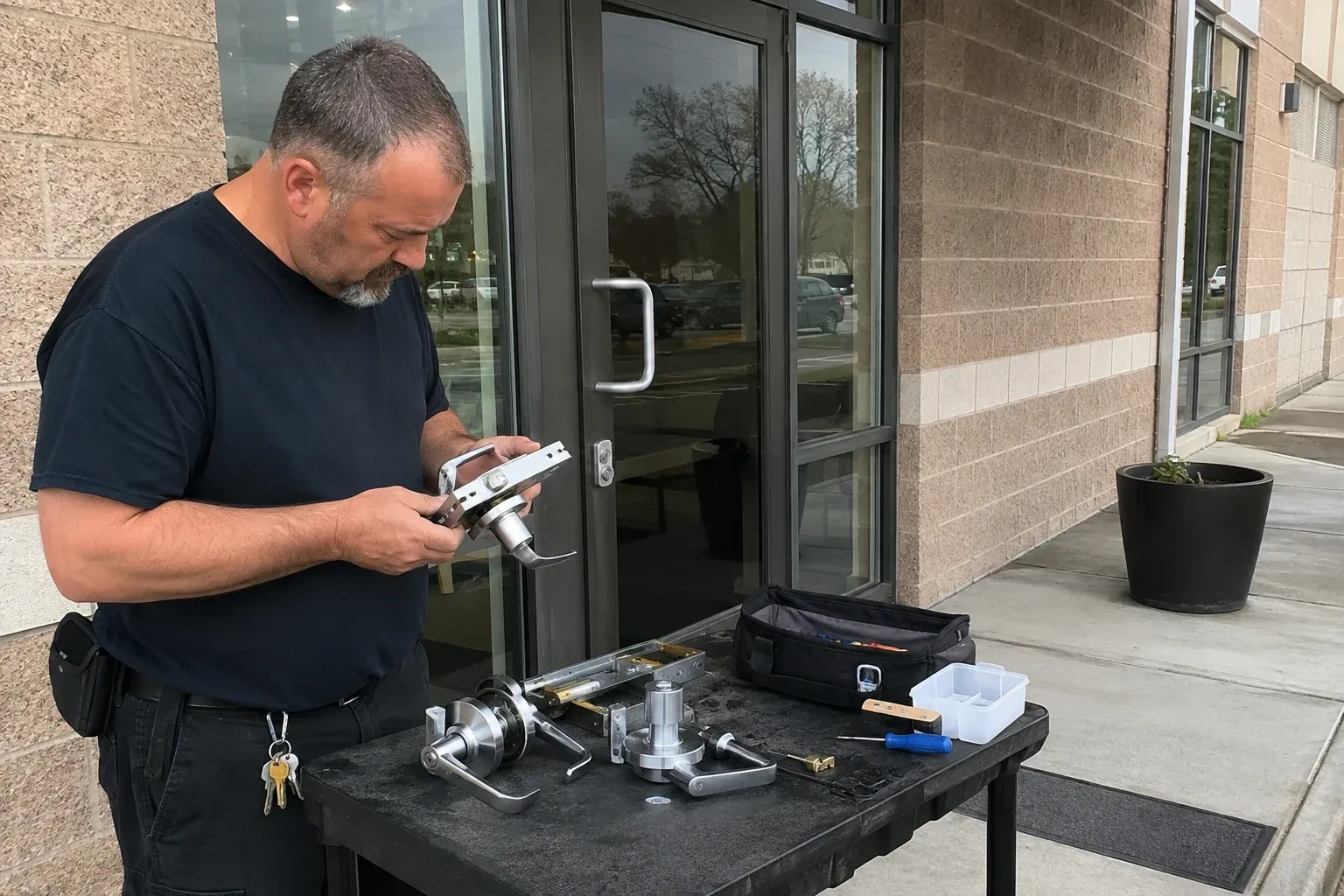
- Master Key System DesignA property manager taking over a small commercial building inherits a shoebox of keys with no…
- Access Control InstallationAnother employee left and the keys never came back.
- Panic & Exit HardwareThe daycare wants the yard gate and the classroom door alarmed so a staff member hears the moment…
Commercial-Grade Lock Replacement near you
For people in Stamford who like to know before they call: these pages describe each lock service in detail, from the routine rekey to the less common safe opening or master key design. They explain the steps, the parts involved and the decisions you may be asked to make on the day.