Commercial · Corwin Crescent
Access Control Installation in Corwin Crescent
Another employee left and the keys never came back. You changed the locks again, cut copies for everyone who stayed, and paid for a job that repeats itself the next time someone quits, taking a working key out the door with them.
Access Control Installation
In plain words
Access control installation swaps a shared metal key for an electronic one: a card, a fob, a code, or a phone tap that a controller checks against a list the business manages. When someone leaves the company, their credential is switched off in seconds instead of triggering a rekey of every door they could open. The reader and locking hardware go in at each entrance that needs it, wired to a controller that holds the schedule, and the whole system is handed to the business to run once it has been tested and confirmed working.
How the visit goesSomething went missing from the storeroom over a weekend, and when you ask who was in the building, the honest answer is anyone with a key. There is no list, no time stamp, no way to narrow it down.
Corwin Crescent
How the visit goes
Checking the network before relying on it
A networked controller usually needs a live network connection to report events and accept schedule changes, so where that option is on the table, the survey includes a look at the building's existing network: is there a switch port near where the controller will sit, does the building's technology policy allow another device on the network, and does a networked system suit the business better than several standalone readers that need no network at all. Answering this before ordering hardware avoids discovering, midway through the job, that the simpler standalone option was the better fit all along.
Wiring the openings back to a controller
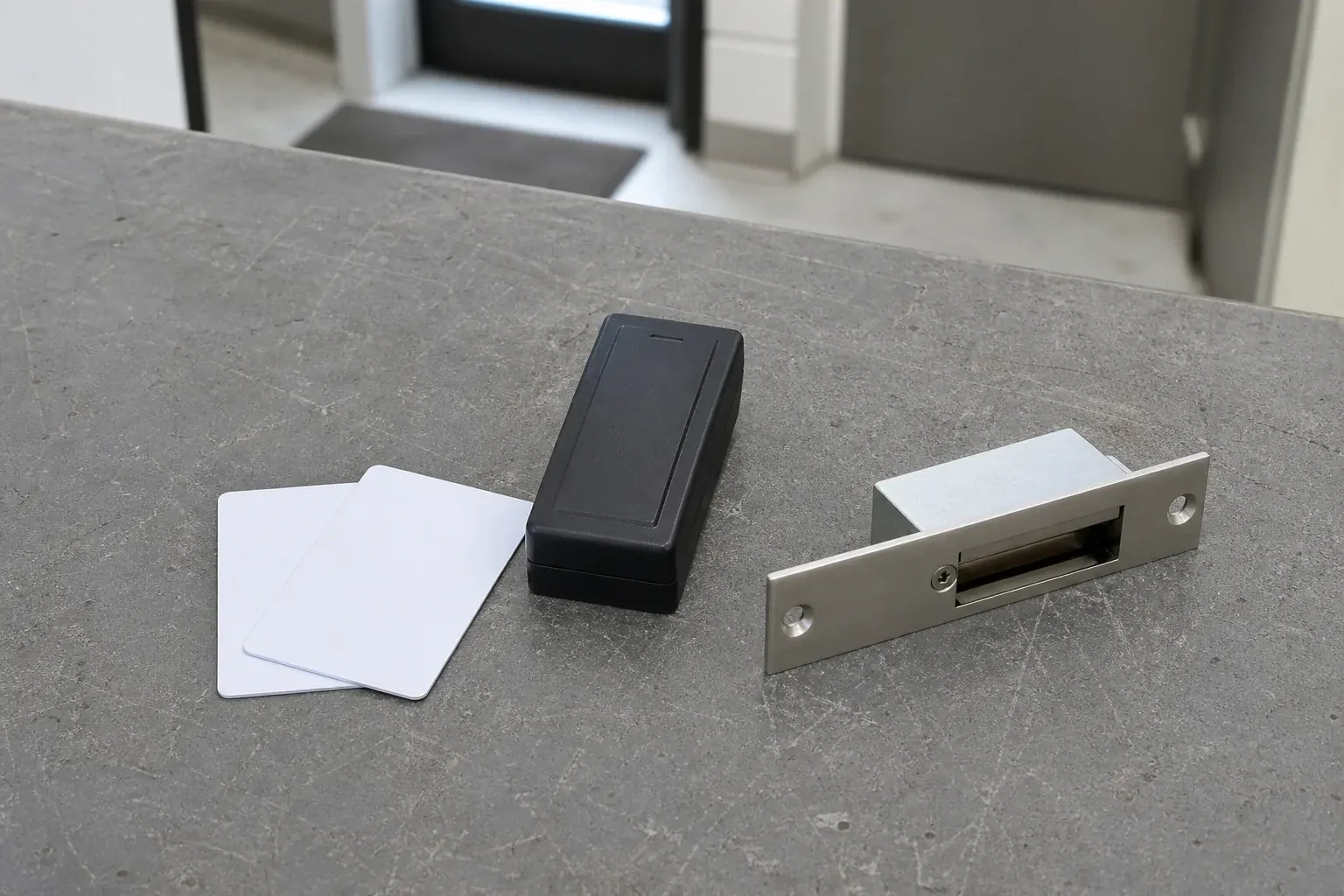
Each controlled opening can send and receive several signals: a reader reporting a presented credential, a lock output that releases the hardware, and, where the configuration calls for them, a door position switch reporting open or closed and a request-to-exit input. The locksmith runs the wiring from each opening back to wherever the controller is mounted — as a home run, along a shared bus, or over the network on an IP or PoE device — labels each conductor at both ends, and terminates them into the controller's input and output boards. A building with several openings may share one power supply and battery backup sized to the combined load, or split the load across more than one supply.
Watching the doors through a change of season
Steel and aluminum frames move slightly with temperature, and a wood door can swell in a humid spell or shrink once the heat comes on for winter, either of which can nudge an electric strike or a magnetic lock's armature plate out of the alignment it was installed with. A door that used to release cleanly and now needs a firm pull, or a magnetic lock that seems to hold less securely than it did in the spring, is usually telling you about the door rather than the electronics, and an alignment check at each change of season keeps it from becoming a pattern.
Access Control Installation
In the van
- Card and fob readers
- Request-to-exit devices
- Electric strikes
- Magnetic locks
- Fire alarm interface relay
What affects the quote
Same fees day, night or weekend
1Electric strike or magnetic lock
An electric strike works with the door's existing latch and generally needs less additional hardware than a magnetic lock, which also calls for a request-to-exit device and, on an exit door, a fire alarm tie-in.
2How many schedules and access levels are needed
A building with one schedule for everyone is quicker to configure than one splitting doors, hours and roles into several access levels, since each combination has to be set up and then tested on its own.
3Power supply and backup sizing
A power supply and battery backup have to be sized to the number of doors and locks they support, and a building with several openings on one controller needs a larger supply than a single standalone unit.
Access Control Installation: questions
Can access control be added to just one door, or does it have to cover the whole building?
A single door with its own standalone reader is a complete installation on its own, and plenty of businesses start there. If more doors need controlling later, a networked controller can be added at that point, or the building can simply add another standalone unit. Nothing about starting small commits the business to expanding, and nothing about a single-door job rules out growing the system later.
Who keeps administrative control of the software after installation?
The business does. Handover includes a full administrator account with the ability to add and revoke credentials, change schedules, and pull an entry log, confirmed working before the locksmith leaves. Whether the installer keeps any support or portal access beyond that is a setting agreed with the business, not a fixed feature of every system, so it is worth confirming as part of that handover.
What's the difference between a standalone and a networked system?
A standalone unit is a self-contained reader and lock at one door, holding its own list of credentials, though it can still need a power or network connection to run. A networked system ties several doors to shared management, sometimes through more than one controller, aggregating schedules and combining logs across all of them. The right choice depends on how many doors need controlling and whether the business wants a single place to manage all of them, rather than one being universally better.
Commercial Locks
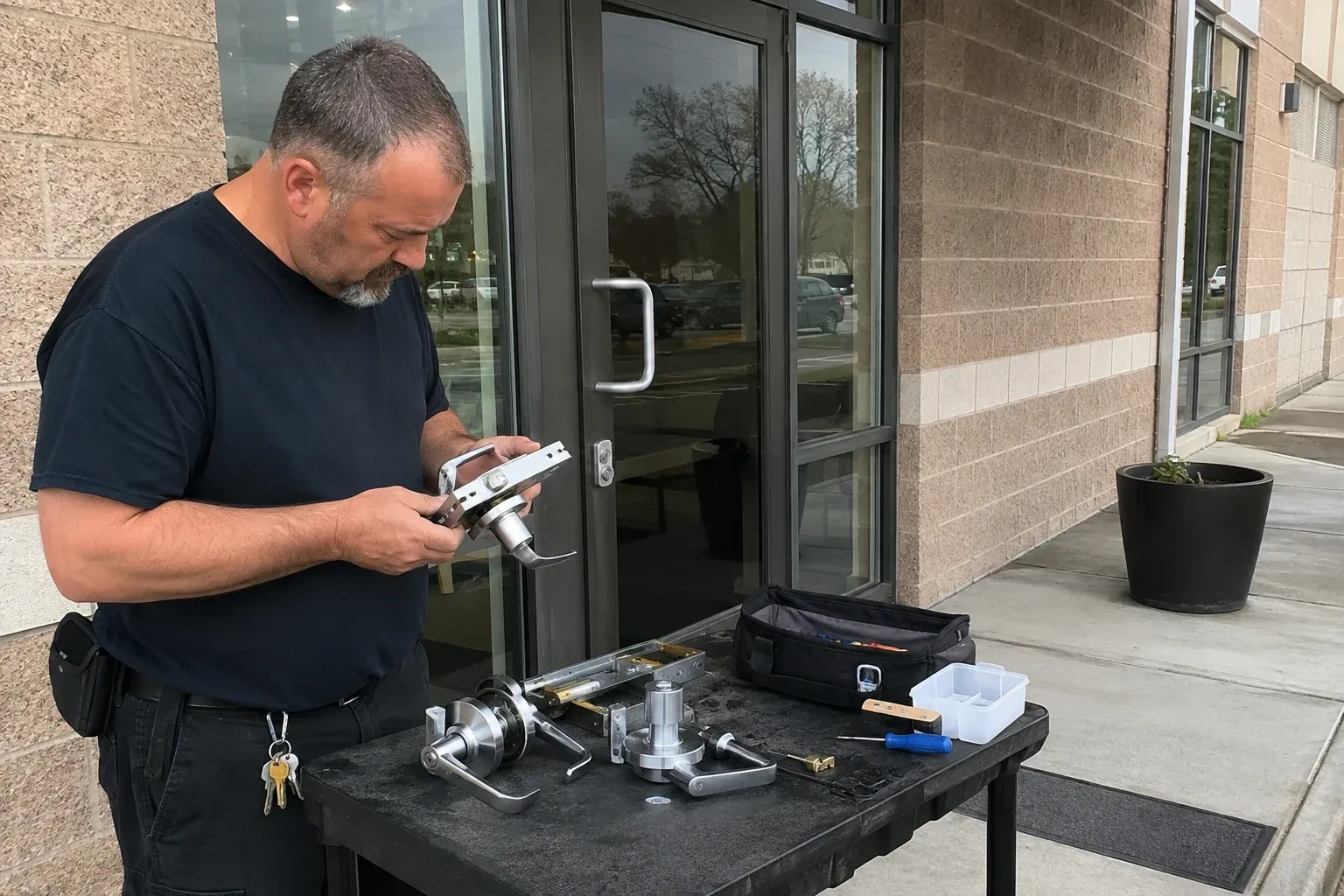
- Master Key System DesignA property manager taking over a small commercial building inherits a shoebox of keys with no…
- Panic & Exit HardwareThe daycare wants the yard gate and the classroom door alarmed so a staff member hears the moment…
- Commercial-Grade Lock ReplacementThe kitchen delivery door gets shouldered open more than a hundred times a shift, and lately the…
Access Control Installation near you
For people in Corwin Crescent who like to know before they call: these pages describe each lock service in detail, from the routine rekey to the less common safe opening or master key design. They explain the steps, the parts involved and the decisions you may be asked to make on the day.